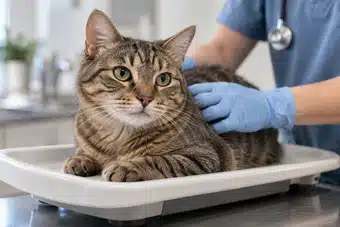
Juniper
Calculation assumptions
$1,000 eligible; $250 remaining deductible; 80% after deductible
Modeled payment
$600
Owner retains
$600 of $1,200 bill

Keep each cat’s policy identity and claim ledger separate when comparing pet insurances for a multi-cat home.
Use these checkpoints to frame the literal question before reading the full guide.
When considering pet insurances for cats, compare each cat’s eligibility and benefits before adding the household totals. Two cats can have different histories and selected terms. The useful test is to follow each invoice through its own eligible expenses, deductible and limit, then add the owner’s remaining costs.
The sections below show how to verify the answer and what can change it.
Imagine an orange cat, Juniper, and a black cat, Moss. Both names, histories and amounts are invented. Juniper has a $1,200 treatment invoice, of which $1,000 is assumed eligible. Moss has a separate $500 invoice, of which $400 is assumed eligible. Nothing in this example diagnoses either animal or establishes real coverage.

| Cat | Calculation assumptions | Modeled payment | Owner retains |
|---|---|---|---|
| Juniper | $1,000 eligible; $250 remaining deductible; 80% after deductible | $600 | $600 of $1,200 bill |
| Moss | $400 eligible; $250 remaining deductible; 80% after deductible | $120 | $380 of $500 bill |
| Household | Assume sufficient separate limits for both | $720 total | $980 of $1,700 total |
This exercise assumes separate deductibles; it does not assert that every multi-cat product uses them. Pooling would need explicit contract evidence. If Juniper had already met her deductible, her modeled payment would rise to $800 under the same assumptions. That would not automatically change Moss’s ledger.
NAIC describes different product categories and reimbursement approaches. A household comparison should therefore label the actual product and calculation method for each cat rather than treating every product called pet insurance as interchangeable.
| Document | Annotation |
|---|---|
| Declarations | Correct name/identity, term and selected benefits |
| History and exclusions | Which prior issues are relevant to this cat |
| Benefit calculation | Deductible basis, percentage, limit and optional charges |
| Claim decision | Eligible lines, excluded lines and remaining balances |
| Renewal notice | New premium and any changed wording to inspect |
If both cats visit the same clinic on the same day, ask for records that clearly assign the services to the correct animal. Keep referral notes with the cat who received the referral. A shared household receipt should not lead to a mixed medical history or duplicate submission of one expense.
Keep policy terms, deductible, reimbursement and limits beside the quote so the comparison stays consistent.
No multi-cat discount, shared-deductible feature or actual price is verified here. The worked example teaches separate ledgers, not a branded offer. If a real policy pools benefits, replace the assumptions with its precise wording before using the totals.
Not necessarily. Look for explicit separate or pooled deductible wording; the example assumes separate deductibles only.
Keep the per-cat selections and any discount conditions behind that total so you can see what changes if one cat’s cover changes.
Keep the policy terms beside the price, then continue to rates when the comparison is clear.